Industry & sector guides
Kyoom regularly publishes guides on SEO and LLM visibility for specific industries and services. Here’s a summary of the most recent posts.

9 articles
Explains why Shopify stores that rank on Google are often passed over by ChatGPT, Perplexity and AI summaries. Platform constraints – thin default structured data, duplicate product URLs, fixed URL prefixes, filter-page bloat and restricted root files – limit AI readability, although native llms.txt support arrived in spring 2026.
Key takeaways
- Extend Shopify's thin default product schema – AI needs materials, specs, use cases and certifications
- Manage duplicate /products/ vs /collections/…/products/ URLs and filter-generated pages
- Check what /llms.txt serves after Shopify took over the path in May 2026; Markets stores need localised versions
- entitymap.json still needs a redirect or Cloudflare Worker workaround
- Aim for green ticks across all four Rich Results categories in Search Console

Argues that the replicability that makes franchising work becomes a liability in local and AI search. Copy-paste location pages, uneven franchisee effort, NAP drift as locations change hands, ad-hoc reviews and no answer engine optimisation leave networks reliant on paid media. Also highlights the overlooked franchisee-recruitment angle.
Key takeaways
- City-swapped boilerplate location pages signal 'nothing local here' to Google and LLMs
- Visibility gaps compound – locations that rank pull further ahead
- Paid search masks weak organic performance and becomes a permanent dependency
- Keep one clean source of truth for NAP data across every location
- Roll out a repeatable review system and AEO-ready FAQ/schema content network-wide
- Strong local visibility doubles as a franchisee recruitment asset

Explains why UK dental practices see impressions rise while clicks fall: AI Overviews and assistants now answer patient questions directly. Sets out a ten-step plan focused on being cited rather than ranked – clear homepage messaging, dedicated treatment pages, conversational FAQs, video, Google Business Profile, steady reviews and wider content distribution.
Key takeaways
- The goal shifts from ranking to being cited as the authoritative source
- Give every treatment its own in-depth page (costs, suitability, recovery)
- Write FAQs the way patients actually ask questions
- Treat the Google Business Profile and consistent NAP as primary assets
- Keep reviews flowing across platforms throughout the year
- Measure branded impressions, enquiries and bookings, not just positions

Travel brands face OTAs and aggregators dominating the results page, while LLMs increasingly compile trip recommendations before any website is visited. Covers eight challenges, from the gap between inspiration content and high-intent queries to seasonal investment cuts, review signals, crawl-heavy booking platforms, generic content and multi-touch attribution.
Key takeaways
- Compete on specificity and niche expertise, not generic terms like 'hotels in Barcelona'
- Write for high-intent comparison queries further down the funnel
- Keep SEO running year-round – LLM authority doesn't snap back after a seasonal pause
- Treat reviews as a structured, multi-platform programme
- Fix crawl budget and duplication on date/filter pages with canonicals and schema
- Track branded search growth and LLM surfacing as KPIs
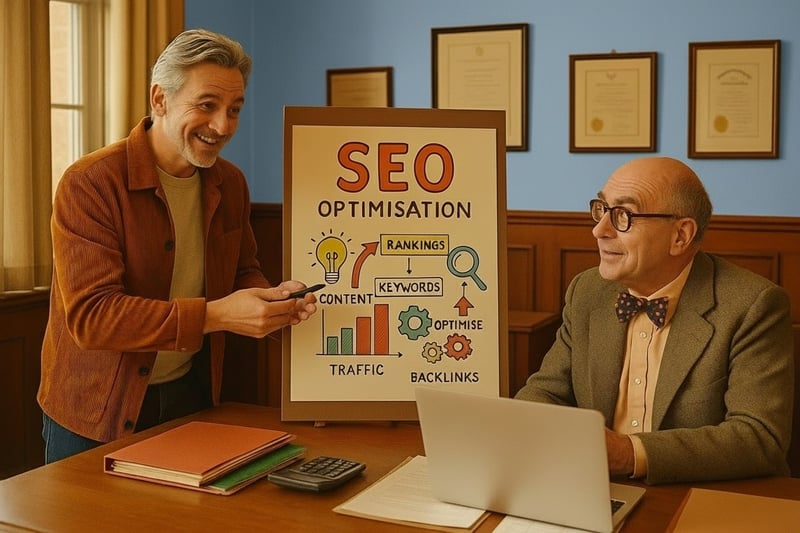
Identifies 'invisibility by default' as the biggest challenge for accountants, solicitors and advisers: reputations built on referrals don't translate into what search engines and LLMs can find. Covers weak local foundations, vague risk-averse content, broken template-site technicals, unaudited AI perceptions and the case for an audit-first approach.
Key takeaways
- Referral pipelines plateau – AI and map-pack queries ignore your network
- Firms with stronger local SEO outrank more capable competitors
- Generic 'proactive, friendly, trusted' copy actively signals low authority
- Use handwritten schema and fix template-theme technical issues
- Audit what LLMs currently say about the firm
- Compliance and clarity aren't in conflict – caution needn't mean blandness

Education providers must stay visible in organic search while becoming a source AI systems trust and cite. Ten challenges are covered, including long multi-audience journeys, generic local SEO templates, 'launch and leave' websites, content silos, multi-campus local SEO, zero-click search, compliance constraints and the unmeasured gap between awareness and enrolment.
Key takeaways
- Map content to each audience (parents, school leavers, adult returners, professionals, international students)
- Pull outcome, accreditation and funding facts out of PDFs and keep them consistent everywhere
- Keep publishing – static sites lose authority with both Google and LLMs
- Align faculty, marketing and admissions behind one content architecture
- Give each campus and delivery mode its own local signals
- Track prospectus requests, open-day bookings and applications, not just traffic

Fintech buyers research over weeks across multiple stakeholders, increasingly via ChatGPT and Perplexity, so the brands AI cites become the shortlist. Covers role-based intent mapping, compliance bottlenecks, model-specific GEO, empty thought-leadership content, gated or JavaScript-heavy sites and authority from trade publications.
Key takeaways
- Build an intent map for each buying role (CFO, compliance, technical evaluator)
- Design compliant messaging upfront rather than retrofitting legal review
- GEO differs by model – Gemini leans on institutions' own pages; ChatGPT, Perplexity and Copilot favour third parties
- Ungate and properly index documentation and product pages
- Earn citations in trade publications, analyst reports and developer communities
- Tie organic and AI visibility to demo requests and enquiries
Trades businesses are losing calls to competitors that appear in AI-generated answers. Rather than becoming content marketers, builders and plumbers need accurate, structured signals. The post outlines four gaps – citations, topic association, broken links and direct-answer content – and walks through Kyoom's AI brand knowledge audit process.
Key takeaways
- Find out what Gemini, ChatGPT, Claude and Sonar currently say about your business
- Keep NAP consistent across trade directories and supplier pages
- Name specific services, sectors and locations plainly on service pages
- Fix broken links and misdirected redirects through an AI-first lens
- Answer real customer questions directly – that's what AI cites
- GEO works alongside SEO, not instead of it
Ten challenges for ecommerce teams still running a pre-AI playbook: chasing vanity head terms, paid-media dependency, search-unfriendly themes, audits without prioritisation, ignoring how LLMs describe the brand, catalogue churn, attribution, platform knowledge gaps, outdated metrics and strategy that never gets executed.
Key takeaways
- Target long-tail, purchase-intent queries – AI Overviews are less dominant on transactional searches
- Build organic equity so revenue doesn't depend on ad spend
- Prioritise audit fixes by revenue impact
- Benchmark how AI tools describe your brand vs competitors
- Redirect retired URLs and keep schema current as the catalogue changes
- Track AI citation frequency and branded search growth