AI search & LLM visibility
Kyoom regularly shares insights on AI search, LLM visibility and the future of discovery. Here’s a summary of the most recent posts.

9 articles
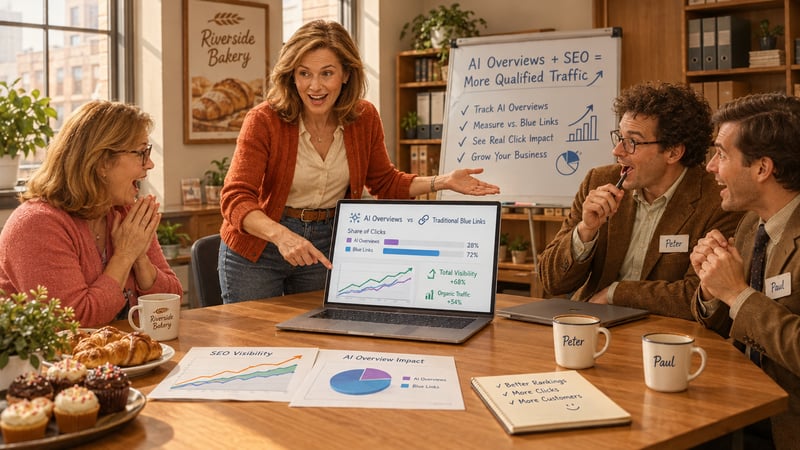
Argues AI visibility metrics mean little in isolation and should be set against Google Search Console organic data. Uses Search Console's generative AI performance report (launched 3 June 2026) to track an 'AI share of impressions' metric, illustrated with an anonymised clinic case study.
Key takeaways
- AI share = AI impressions ÷ total web impressions
- A rising AI share explains falling CTR – exposure has moved, not disappeared
- Page-level comparison sorts URLs into: ranks but not cited / cited despite weak rankings / strong or weak on both
- Works as an early trend indicator for each sector
Media-hit and reach counts no longer prove visibility in an AI-mediated world. LLMs deprioritise wire-distributed press releases, while genuine editorial coverage in trusted outlets becomes a trust signal. PR agencies need citation-share reporting plus entity and structured-data skills.
Key takeaways
- Report citation share / AI visibility alongside clip counts
- Earn independent editorial coverage rather than wire blasts
- Rebuild media lists around outlets AI engines actually cite
- Concentrated niche coverage compounds – specialist agencies have an edge
- Be wary of cherry-picked stats when selling AI visibility

PBN usage can't be counted directly, but the economics behind them are collapsing: AI Overviews have absorbed the informational and low-intent commercial queries PBNs were built to rank for. The replacement playbook is entity authority, structured data and becoming the source AI systems cite.
Key takeaways
- PBN viability can be inferred from click loss on their target queries
- Informational queries are hit hardest
- Zero-click search removes the incentive to build link equity
- Industry focus has shifted to citation engineering, entity authority, schema and brand-query optimisation

Draws on a Search Engine Land study (150,000 pages, 10 sites, one month) showing that ranking on Google and being cited by AI are often separate outcomes. AI tools cite original data and analysis far more than generic how-tos, and service/product pages win a disproportionate share of AI referrals.
Key takeaways
- Lead every page with a direct, extractable answer
- Make original data the headline, not a footnote
- Optimise service/product pages and interactive tools for AI referrals
- Treat GEO as a parallel discipline to SEO, not a replacement

A practical, opinionated guide to using LLMs to generate the 'bones' of website copy, with separate templates and writing styles for different page types. Stresses patience, repeated prompt refinement and a strong bank of source content, noting that LLMs now reward a conversational, question-answering style.
Key takeaways
- Build separate templates per page type (blog, service, FAQ, local, lead-gen), each with its own JSON schema
- Use a clear H1/H2 structure; content depth and entity coverage matter
- Impatience with prompt refinement is the main failure point
- Training on many authors produces mixed styles – brief carefully
- Home pages ('album covers') are the hardest to generate

Search is moving beyond typed keywords to combined image, voice, video and text queries (e.g. Google Lens). The post explains the underlying technology and sets out optimisation steps: richer image SEO, contextual content across formats, schema, mobile performance and solid local search foundations.
Key takeaways
- Descriptive file names, alt text and structured data for images; balance quality with compression (WebP)
- Back up visual queries with rich text, video and reviews
- Use FAQ sections for conversational/voice queries
- Avoid JavaScript-heavy platforms without server-side rendering
- Nail Google Business Profile, reviews and consistent brand facts first

Argues the real risk to SEO is lethargy, not AI. Covers the shift from search engine to answer engine, the CTR impact of AI Overviews, measurement gaps and the rise of GEO, and makes the case for strategic thinking, communication and business understanding as future-proof skills.
Key takeaways
- Being cited in AI Overviews is the new 'position zero'
- Measurement of AI citations is still immature
- Average content plus a few backlinks no longer works
- Use AI to assist, not replace, judgement
- Communication, relationships and business understanding are the key SEO skills

A business-friendly comparison of four AI assistants: Sonar (Perplexity) for live, cited research; ChatGPT for creative and educational work; Gemini for Google-integrated multimodal tasks; and Claude for careful, long-form reasoning in sensitive settings. Recommends a blended AI stack mapped to team workflows.
Key takeaways
- No single platform wins across every business function
- Match tools to teams (marketing, research, legal/compliance, Google-centric)
- Blend tools so they cover each other's blind spots
- Treat AI output as draft material that needs verification
- Ties into Kyoom's AI brand knowledge audits

A five-year outlook for online commerce in which AI is a catalyst rather than a threat. Contrasts a best case (personalised, conversational, customer-centric commerce) with a 'do nothing' worst case, noting most businesses will land in between and that SEO fundamentals remain the entry ticket to AI summaries.
Key takeaways
- AI results often pull from pages already on page one – SEO foundations still matter
- Discovery now spans search, social and AI assistants
- When everyone has the same AI tools, human judgement differentiates
- Inaction leads to falling visibility, poorer service and lower conversion