Biggest Challenge for Professional Services Firms in Search and LLM Marketing
Grant Whiteside · 30 April 2026
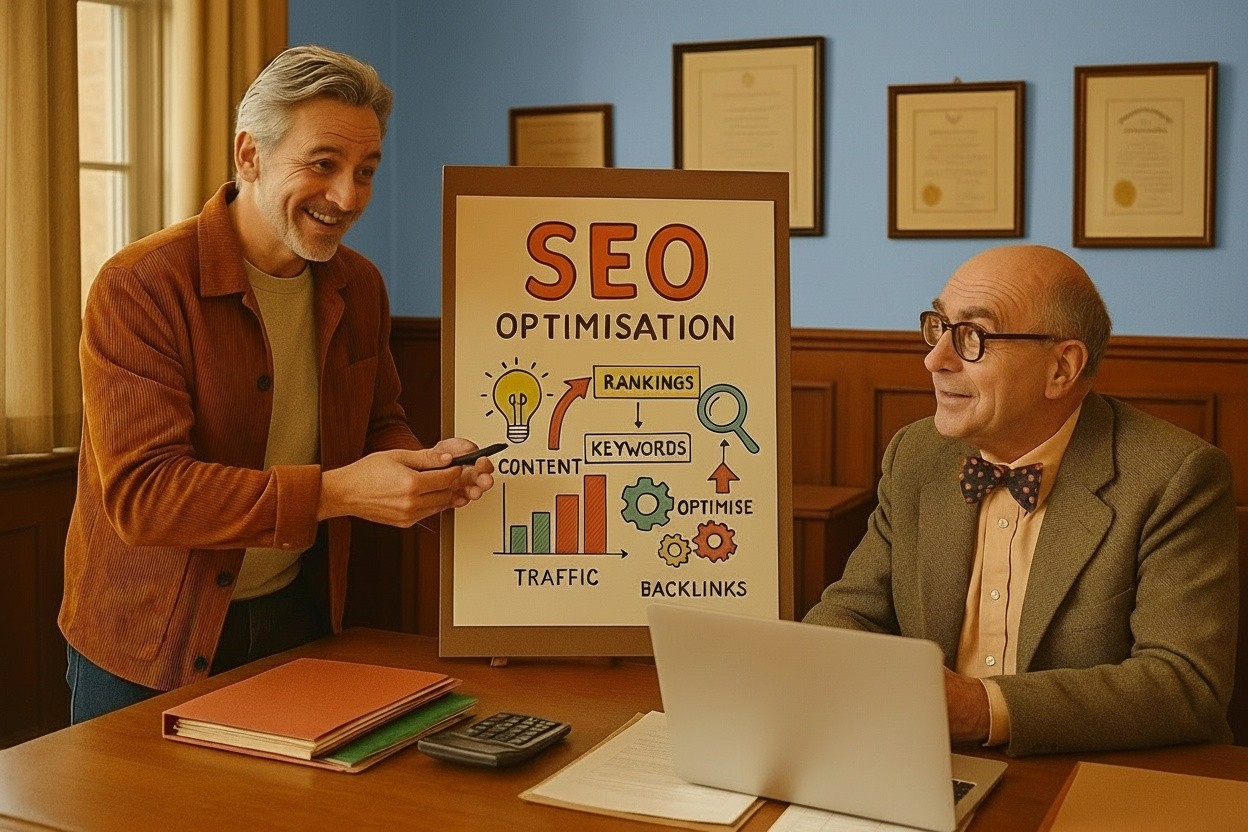
You Are Invisible, and You Do Not Know It
Most professional services firms, including accountants, solicitors, tax advisors, and consultants, spend years building a reputation through referrals, word of mouth, and client relationships. That model worked. But search engines and AI language models do not know your reputation. They know what they can find, read, and verify about you online. And for many firms, what they find is very little.
That is the central challenge. Not budget, not competition, not even technical complexity. The biggest obstacle facing professional services firms in search and LLM marketing today is invisibility by default, built up over years of treating digital presence as an afterthought.
The Referral Comfort Zone Has an Expiry Date
Referrals are genuinely valuable. A recommendation from a trusted contact carries weight that no search result can replicate. But referral pipelines eventually plateau. They depend on your existing network, and they reach only the people who already know someone who knows you.
When a business owner types "accountant for construction company near Leeds" into Google, or asks ChatGPT to recommend a tax specialist for a specific industry, your referral network is irrelevant. What matters in that moment is whether your digital presence is structured to answer that query authoritatively. For most mid-size professional services firms, it is not.
The Local Search Problem Is More Urgent Than Most Firms Realise
Search for almost any accounting or professional services term with a location attached, and what appears first is the AI overview or the local map pack: three businesses, their reviews, their proximity, and their profile completeness. This is the decision-making layer for a huge proportion of potential clients.
The problem is systemic across the sector. Google Business Profiles are incomplete or unclaimed. NAP data, which is your Name, Address, and Phone number, is inconsistent across directories. Reviews are sparse or non-existent. Location pages on websites are either absent or consist of a single paragraph with a postcode dropped in.
The result is that firms with weaker credentials but stronger local SEO foundations consistently outrank more capable competitors. A boutique accountancy firm with a polished Google Business Profile, 40 verified reviews, and consistent citations will appear above a long-established practice that has done none of this work.
Generic Content Is Actively Working Against You
Many professional services firms do not realise that publishing thin, generic content does not simply fail to help. It actively signals low authority to both search engines and AI models.
Pages that describe a firm as "proactive, friendly, and trusted" without specificity, proof, or depth are treated as low-value by Google's ranking systems. They provide no useful signal for LLMs trying to determine what a firm actually specialises in, who it serves, and whether it can be cited as a reliable source.
The content problem in professional services stems from risk aversion. Firms in regulated industries worry about saying the wrong thing, so they end up saying almost nothing. The result is a website full of safe, vague statements that rank for nothing and convert no one.
Strong content for professional services needs to address specific client problems, reference specific sectors, and demonstrate genuine expertise. A page explaining the tax implications of an R&D claim for a software SME will outperform a generic "business tax" page every time, both in organic search and in LLM citations.
Technical Foundations Are Broken at Scale
Template websites built on off-the-shelf accountancy themes look acceptable visually, but their technical infrastructure is typically inadequate for competitive search. Pages load slowly. Schema markup is absent or auto-generated incorrectly. Crawl architecture is poorly structured. Internal linking is haphazard.
Search engines rely on structured data to understand what a page is about, who provides the service, where they operate, and what qualifications or credentials they hold. Without properly implemented schema, a firm's expertise is invisible to the systems making ranking decisions. Without fast, crawlable, well-structured pages, even good content fails to perform.
This matters more now than it did three years ago, because LLMs also depend on structured, semantically clear content when building their knowledge about a brand or business. If your site is technically broken, AI models will either misrepresent your firm or omit it entirely from relevant responses.
The LLM Problem: You Have No Idea What AI Is Saying About You
This is perhaps the most underappreciated challenge in professional services marketing right now. LLMs such as ChatGPT, Gemini, Perplexity, and others are increasingly used by prospective clients to research service providers, understand industry options, and potential shortlists to contact. These systems do not use your website in real time. They draw on training data, indexed content, citations, and the broader digital footprint your firm has built over time.
Most professional services firms have never audited what LLMs know about them. The answer, in most cases, is: not much, or worse, something inaccurate. Competitors who have invested in a depth of good conten, earned media, citations in trade publications, and structured data are being surfaced in AI-generated responses. Firms that have not are absent from those conversations entirely.
Sadly his is not a hypothetical future concern anymore. Clients are already asking AI tools for recommendations. The firms appearing in those recommendations are not always the best firms. They are the most visible ones in the data that AI systems have already consumed.
The Regulated Environment Creates a Unique Tension
Professional services firms operate within compliance frameworks that restrict how they can present their services. Accountants cannot make certain guarantees. Solicitors cannot imply guaranteed outcomes. Financial advisors face strict rules around the language they use.
This regulatory reality makes many firms overly conservative across all their communications, including their marketing. The fear of saying something incorrect bleeds into a culture of saying nothing distinctive at all.
But compliance and clarity are not in conflict. A well-structured content strategy for an accountancy firm can demonstrate deep sector expertise, explain complex tax planning approaches in clear terms, and position the firm as the obvious choice for a specific client type, all while staying fully within professional obligations. The constraint is not the regulation. The constraint is the assumption that caution must equal blandness, but this is something that can be easily overcome.
The Audit Gap: Acting Without Knowing Where To Start
One of the most common failures in professional services marketing is implementing changes, whether a new website, a blog programme, or a social media presence, without first understanding what is actually broken.
Without a full technical, content, and conversion audit, a lot of SEO work is speculative. Firms spend budget on new pages while their existing pages have fundamental indexability problems. They invest in content while their site structure prevents any individual page from accumulating authority. They fix their homepage while their service pages carry duplicate content penalties.
An audit-first approach changes this entirely. It identifies where crawlability breaks down, where content is thin or duplicated, where tracking is missing, and where conversion paths fail. It separates the quick wins from the structural work and prioritises effort accordingly.
What Winning Actually Looks Like in This Space
Firms that are performing well in search and appearing in LLM responses share a recognisable set of characteristics.
Their websites are technically clean: fast to load, properly structured, with handwritten schema that accurately describes their services, locations, and expertise. Their content addresses specific client scenarios with depth and precision rather than generic descriptions of services. Their Google Business Profiles are fully optimised, regularly updated, and supported by a consistent stream of genuine client reviews. Their local citations are consistent across every major directory.
Beyond search, their digital footprint extends into the sources that LLMs draw from: trade publications, industry directories, press coverage, and third-party mentions that confirm what the firm does, who it serves, and where it operates. That combination of on-site authority and off-site citation creates the signal density that both search engines and AI models use to determine whether a firm is worth surfacing.
The Pace of Change Is Not Slowing Down
The professional services sector has historically been slow to adopt digital marketing, and that lag is now compounding. Generative AI is reshaping how prospective clients find and evaluate service providers at the same time as traditional search engine results pages are becoming more competitive and more locally differentiated.
Firms that begin addressing their technical foundations, content depth, local presence, and LLM visibility now will hold a meaningful advantage over those that wait. The gap between firms that are well represented in AI-generated responses and those that are absent is already widening.
The professional services market has always rewarded trust and expertise. The shift underway is not a change in what clients want. It is a change in where and how they look for it, and whether they find you when they do.
Frequently asked questions
Why are professional services firms invisible in search and AI results despite having strong reputations?
Search engines and AI language models cannot see your reputation. They can only find, read, and verify what exists about you online. Most professional services firms have spent years building credibility through referrals and relationships while treating their digital presence as an afterthought. The result is invisibility by default, regardless of how strong the firm actually is.
Will our referral pipeline not be enough to sustain growth?
Referrals are valuable but they plateau. They depend on your existing network and only reach people who already know someone who knows you. When a business owner searches for an accountant or tax specialist in a specific location, or asks an AI tool for a recommendation, your referral network plays no part in whether you appear. What matters is whether your digital presence is structured to answer that query authoritatively.
How much does local SEO really affect which accountancy firms get found?
The impact is significant and immediate. The local map pack, three businesses with reviews, proximity, and profile completeness, is the first decision-making layer for a large proportion of potential clients. Firms with incomplete Google Business Profiles, inconsistent directory listings, and sparse reviews are routinely outranked by less experienced competitors who have simply done the local SEO groundwork. A polished profile with verified reviews will consistently appear above a long-established practice that has neglected this entirely.
Is publishing general content about our services not good enough for SEO?
Generic content does not simply fail to help, it actively signals low authority to both search engines and AI models. Pages that describe a firm as proactive and trusted without specificity, proof, or depth are treated as low-value. Strong content must address specific client problems, reference specific sectors, and demonstrate genuine expertise. A page explaining the tax implications of an R&D claim for a software SME will outperform a generic business tax page every time, in both organic search and LLM citations.
Our website looks professional. Does the technical side really matter that much?
Visual appearance and technical performance are not the same thing. Template websites built on off-the-shelf themes often load slowly, lack proper schema markup, have poorly structured crawl architecture, and use haphazard internal linking. Search engines rely on structured data to understand what a page is about, who provides the service, and where they operate. Without it, your expertise is invisible to the systems making ranking decisions. LLMs also depend on structured, semantically clear content; if your site is technically broken, AI models will either misrepresent your firm or omit it entirely.
What are AI tools like ChatGPT and Perplexity actually saying about our firm?
Most professional services firms have never checked, and the answer is often very little, or something inaccurate. LLMs draw on training data, indexed content, citations, and the broader digital footprint a firm has built over time. Competitors who have invested in content depth, earned media, and structured data are being surfaced in AI-generated responses. Firms that have not invested in this are absent from those conversations entirely, even when a prospective client is actively looking for exactly what they offer.
Can we produce strong marketing content while staying within professional and regulatory obligations?
Yes. Compliance and clarity are not in conflict. A well-structured content strategy can demonstrate deep sector expertise, explain complex approaches in plain terms, and position a firm as the obvious choice for a specific client type, all while remaining fully within professional obligations. The constraint is rarely the regulation itself. It is the assumption that caution must equal blandness, which leads to websites full of safe, vague statements that rank for nothing and convert no one.
Why should we audit before making any SEO or content changes?
Without a full technical, content, and conversion audit, any SEO work is speculative. Firms routinely spend budget on new pages while existing pages have fundamental indexability problems, or invest in content while their site structure prevents any individual page from accumulating authority. An audit-first approach identifies where crawlability breaks down, where content is thin or duplicated, where tracking is missing, and where conversion paths fail, separating quick wins from structural work and ensuring effort is prioritised correctly.
Is there still time to act, or have firms that started earlier already locked up the advantage?
The window is still open but it is narrowing. Generative AI is reshaping how prospective clients find and evaluate service providers at the same time as traditional search results are becoming more competitive and locally differentiated. The gap between firms that are well represented in AI-generated responses and those that are absent is already widening. Firms that begin addressing their technical foundations, content depth, local presence, and LLM visibility now will hold a meaningful advantage over those that continue to wait.
More insights from the blog



Still have questions? Get in touch for a free strategy session.